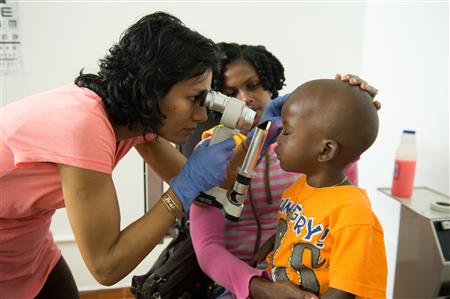
“It's late at night in Haiti after another long day at the clinic. Before I try to get a few hours of sleep, I wanted to share a few experiences from this week that I haven't been able to stop thinking about.”
Dr. Anshu Chandra, Director of the Haiti Eye Clinic, Global Eye Project, optometrist and dedicated volunteer recently shared what it’s like to work at the clinic with patients who travel long distances and overcome extreme heat and hunger to reach eye care.
“The days here are intense. Every day feels like a race against blindness.”
Many patients arrive on the verge of losing vision forever. One has advanced glaucoma. Another has a severe infection threatening an eye. Someone else is losing sight from diabetes or hypertension. A newborn arrives needing urgent care. Then come the children, which are often the most emotionally taxing cases for Chandra and her team.
“Sometimes the treatments we provide are uncomfortable. Sometimes they are painful. Sometimes they require procedures that even adults struggle to tolerate, let alone children,” says Chandra. “There are moments when my heart aches.”
Dr. Chandra’s charitable eye missions to rural Fond-des-Blancs in Haiti began in 2008, when she recognized the acute need for a more permanent eye care clinic for the population, 90% of whom live in poverty.
After several years operating mobile clinics with increasing demand, the team began seeking a permanent space in 2012. In 2015, the Global Eye Project launched a full-time eye clinic in partnership with a local hospital. Over time, they introduced new services, such as a Retinopathy of Prematurity (ROP) screening program to preserve eyesight for infants born prematurely. As word of the clinic spread, their program attracted a high volume of individuals and families seeking care.
“You move from one patient to the next, knowing that every decision matters. You do your best with the resources available, trying to preserve as much sight as possible,” remarked Chandra. “You wish you could help everyone. You wish you had more medications, more equipment, more resources, and more time.”
When Dr. Chandra’s team received word that they would need to vacate their current space, which they had far outgrown, she began fundraising to build an independent, stand-alone clinic and obtained land to do just that.
Now, with a looming deadline of the end of 2027, Dr. Chandra is seeking support from individuals and organizations who believe in her mission.
“We have made great progress so far, but we still need to raise $450,000 by the end of 2026 in order to move forward with construction on the new clinic.”
Chandra, a member of the Niskayuna Rotary Club, immediately connected with other clubs in the area, garnering support to advance the project. “I am exhausted. I know our team is exhausted too. But when I think about the patients we saw this week, I am reminded why every long day is worth it. And the Rotarians in our district see the value in eye care accessibility and prevention efforts for underserved communities like Fond-des-Blanc. This keeps us motivated to move forward because we know we are truly helping those in need.”
Dr. Chandra has so many stories of patients who have already benefitted from the work of the Global Eye Project.
“Yesterday morning, an 11-year-old boy appeared at our clinic door. His school principal had sent him.”
Chandra explained that the boy had broken his glasses two days earlier. Without glasses, he could not even see the largest letters on a vision chart.
“When he arrived at the clinic it was 9:00 AM, and he had a final exam at school beginning at 10:00 AM. We found a pair that was close enough to help him function until we could complete a full examination and obtain custom lenses for him,” she said, smiling. “As I watched him leave for school, I couldn't stop thinking about how easily this story could have ended differently.”
The week before, Chandra and her team had visited the boy’s school and spoken to students, teachers, and parents about vision. They shared that a child who appears to be struggling in school may actually be experiencing difficulty with eyesight.
The principal remembered this information and sent the student to the clinic.
“Without that intervention, a child who could not even see the largest letters on a chart would have been sitting for his final exams. That morning, a pair of glasses may have changed the course of his education.”
The work of the Global Eye Project isn’t just about eyes; it’s about preserving opportunity. It’s about hope.
Recently, a generous Rotary Arch Klumph Society member has offered to match donations to the Global Eye Project dollar-for-dollar, up to $250,000 until November 30. If you or your Rotary Club would like to get involved with supporting the Global Eye Project, please visit www.globaleyeproject.org.
Many patients arrive on the verge of losing vision forever. One has advanced glaucoma. Another has a severe infection threatening an eye. Someone else is losing sight from diabetes or hypertension. A newborn arrives needing urgent care. Then come the children, which are often the most emotionally taxing cases for Chandra and her team.
“Sometimes the treatments we provide are uncomfortable. Sometimes they are painful. Sometimes they require procedures that even adults struggle to tolerate, let alone children,” says Chandra. “There are moments when my heart aches.”
Dr. Chandra’s charitable eye missions to rural Fond-des-Blancs in Haiti began in 2008, when she recognized the acute need for a more permanent eye care clinic for the population, 90% of whom live in poverty.
After several years operating mobile clinics with increasing demand, the team began seeking a permanent space in 2012. In 2015, the Global Eye Project launched a full-time eye clinic in partnership with a local hospital. Over time, they introduced new services, such as a Retinopathy of Prematurity (ROP) screening program to preserve eyesight for infants born prematurely. As word of the clinic spread, their program attracted a high volume of individuals and families seeking care.
“You move from one patient to the next, knowing that every decision matters. You do your best with the resources available, trying to preserve as much sight as possible,” remarked Chandra. “You wish you could help everyone. You wish you had more medications, more equipment, more resources, and more time.”
When Dr. Chandra’s team received word that they would need to vacate their current space, which they had far outgrown, she began fundraising to build an independent, stand-alone clinic and obtained land to do just that.
Now, with a looming deadline of the end of 2027, Dr. Chandra is seeking support from individuals and organizations who believe in her mission.
“We have made great progress so far, but we still need to raise $450,000 by the end of 2026 in order to move forward with construction on the new clinic.”
Chandra, a member of the Niskayuna Rotary Club, immediately connected with other clubs in the area, garnering support to advance the project. “I am exhausted. I know our team is exhausted too. But when I think about the patients we saw this week, I am reminded why every long day is worth it. And the Rotarians in our district see the value in eye care accessibility and prevention efforts for underserved communities like Fond-des-Blanc. This keeps us motivated to move forward because we know we are truly helping those in need.”
Dr. Chandra has so many stories of patients who have already benefitted from the work of the Global Eye Project.
“Yesterday morning, an 11-year-old boy appeared at our clinic door. His school principal had sent him.”
Chandra explained that the boy had broken his glasses two days earlier. Without glasses, he could not even see the largest letters on a vision chart.
“When he arrived at the clinic it was 9:00 AM, and he had a final exam at school beginning at 10:00 AM. We found a pair that was close enough to help him function until we could complete a full examination and obtain custom lenses for him,” she said, smiling. “As I watched him leave for school, I couldn't stop thinking about how easily this story could have ended differently.”
The week before, Chandra and her team had visited the boy’s school and spoken to students, teachers, and parents about vision. They shared that a child who appears to be struggling in school may actually be experiencing difficulty with eyesight.
The principal remembered this information and sent the student to the clinic.
“Without that intervention, a child who could not even see the largest letters on a chart would have been sitting for his final exams. That morning, a pair of glasses may have changed the course of his education.”
The work of the Global Eye Project isn’t just about eyes; it’s about preserving opportunity. It’s about hope.
Recently, a generous Rotary Arch Klumph Society member has offered to match donations to the Global Eye Project dollar-for-dollar, up to $250,000 until November 30. If you or your Rotary Club would like to get involved with supporting the Global Eye Project, please visit www.globaleyeproject.org.